When Electronic Trading professionals discuss liquidity, they are usually focused on the liquidity in the markets they are trading on. Now though, another form of liquidity is becoming increasingly important in their world, presenting new opportunities, but also potential risk. Liquid cooling has entered the conversation.
Opportunity, cost and risk
Performance has always been a talking point in electronic trading. RegNMS and MIFID may have supercharged the conversation as fragmentation and high frequency trading strategies took the headlines, but the reality both before and afterwards was that once machines entered the trading equation the genie was out of the bottle.
Technology was no longer a constraining factor, but presented an ongoing set of opportunities to trade smarter and faster. Yes there was cost associated with this, but weighing heavily on most minds was the opportunity cost and risk of not keeping up with the latest technology trends.
The market in turn has not stood still. Increasing data rates, 24 hour trading and continued volatility mean that technology continues to play a key role in meeting business demands.
When the solution becomes the problem
New technology of course is a great solution to apply to this changing landscape, but it comes with its own challenges, requiring careful cost and risk analysis of any new implementations.
An example of this would be that as chip speeds have increased to keep pace with faster markets, the amount of heat they give off has also risen dramatically. Yet these new architectures have to live in the same colocation facilities that were built with a previous generation of air cooling technology. Moving entire trading ecosystems into new facilities is a complex and risky undertaking, so new technology is again required, in this case the implementation of liquid cooling.
Whilst providing a step change in cooling performance, liquid cooling comes with it’s own risks, particularly in older colocation facilities that were not designed to support it at scale. Aside from disruptive facilities work required to enable liquid cooling, having water on the colocation floor amidst such critical electronic infrastructure involves raising risk profiles beyond what is comfortable for many.
Mitigating liquidity risk
ZutaCore® has designed the HyperCool® system to directly address the cooling, and performance challenges of high performance computing while mitigating operational and environmental risks associated with traditional liquid cooling solutions.
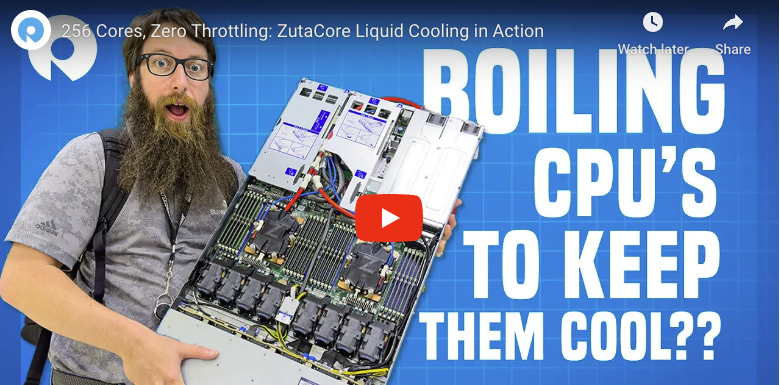
At the server layer, ZutaCore® utilizes waterless, two-phase dielectric direct-to-chip cold plates. This means no water near electronics and self regulating thermal control at the chip itself. This enables extreme heat-flux removal and sustained performance, even during peak market conditions.
At the wider facility layer ZutaCore® integrates with existing water systems, enables higher facility water temperatures and eliminates the need for chillers meaning PUE and WUE improvements and operational efficiency.
Opportunity and the future
Of course, technology does not stand still. Even as trading firms start to deploy liquid cooling into their current colocated systems, a new opportunity is causing them to update their risk profiles yet again.
The advent of AI has the potential to help trading firms implement smarter trading analysis and models, but even more so than traditional CPU architectures, AI demands a step-jump in power and cooling requirements in order to power new GPU and memory architectures both for training and inference.
Where this next generation of compute technology will sit is up for grabs. Will existing trading colocation facilities be able to take on the higher load and enhance the value of their ecosystems, or will new players enter the arena to provide alternatives?
One thing is for sure. Trading firms should only have to worry about market liquidity, not the liquid cooling their systems, and at ZutaCore® our goal is to make sure they have the tools to achieve this.
Find Out More
Learn how ZutaCore is supporting the Financial Services & HFT market here: The ZutaCore Solution for High Frequency Trading
Frequently Asked Questions
Why do electronic trading firms need liquid cooling?
Chip power has risen faster than air cooling can handle, and air-cooled halls hit a thermal ceiling that forces processors to throttle. Liquid cooling removes heat at the source, so servers hold peak performance when volatility spikes.
Does liquid cooling mean putting water next to critical trading infrastructure?
No. ZutaCore HyperCool circulates a waterless, nonconductive heat transfer fluid through cold plates on the chip in a sealed closed loop, removing the leak-damage risk associated with water-based liquid cooling.
What is two-phase direct-to-chip cooling?
Two-phase cooling uses a change of state to move heat. The fluid boils on the cold plate, absorbing energy as it turns to vapor, then condenses in a heat rejection unit and returns. The boiling point self-regulates temperature at the processor.
Can liquid cooling be retrofitted into an existing colocation facility?
Yes. The server loop is self-contained and the system ties into existing water infrastructure at higher supply temperatures, eliminating chillers. Trading firms raise rack density in place instead of migrating to a new site.
How much heat can waterless two-phase cooling remove?
ZutaCore HyperCool supports processors above 4,000 watts of thermal design power and heat flux above 250 watts per square centimeter, covering both current trading platforms and accelerator-based systems.
What do artificial intelligence workloads mean for trading data centers?
Machine learning raises power and cooling demand sharply, because accelerators and high-bandwidth memory draw far more per rack than traditional trading platforms. Facilities either add thermal capacity or lose those workloads elsewhere.
Does liquid cooling improve energy and water efficiency?
Waterless two-phase cooling cuts cooling energy by roughly 74 percent versus single-phase, and chiller-free operation improves power usage effectiveness and water usage effectiveness. No evaporative water is consumed.
Air cooling or liquid cooling for trading infrastructure?
Air cooling works at lower densities but loses ground as chip power rises. Liquid cooling delivers higher density in the same footprint with steadier thermal performance, and waterless two-phase adds no water on the colocation floor.
 Stewart Orrell
%20(2).png)


 Alison Deane : May 15, 2025, 12:35:49 PM