More AI compute. Less infrastructure burden.
AI is advancing at an extraordinary pace. The infrastructure behind it is scaling just as quickly, and communities are asking an increasingly important question: what will this mean for us?
Will AI infrastructure consume more of our electricity? Will it compete for scarce water? Require new power plants and grid buildouts that communities never signed up for?
These are not objections to AI. They are legitimate questions about how we choose to build the infrastructure that supports it. At ZutaCore®, we don't believe the answer is to slow AI down. We believe the answer is to build its physical infrastructure differently.
The Problem Isn't Just Engineering Anymore
For decades, data centers evolved gradually. Power densities crept up, and air and chilled-water cooling kept pace. AI broke that pattern. Today’s GPUs and CPUs concentrate extraordinary compute - and extraordinary heat - into a fraction of the space.
That makes cooling a power problem. A water problem. A land-use and grid problem. Increasingly, a community problem.
If the industry's only response is bigger cooling plants, more electricity, and more water, we are building a model communities cannot sustain. There is another path.
From Cooling Technology to Infrastructure Stewardship
ZutaCore was founded on a simple premise: there had to be a better way to remove heat from computing. Our HyperCool® platform uses waterless, two-phase direct-to-chip cooling to pull heat directly from the processor through phase change, without relying on gallons of water and large mechanical cooling plants.
In independent testing, HyperCool has reduced cooling energy consumption by up to 82% and pumping power by roughly 80% compared with water-based systems, while supporting three times the processing capacity in the same rack footprint. At the University of Münster, a 2MW HyperCool deployment is projected to save more than $1 million annually while allowing energy otherwise consumed by cooling to be redirected toward research computing. None of it requires a drop of water at the server.
The result is a different question for the industry to ask. Not simply, "How many megawatts can we build," but ”How much useful AI compute can we deliver from every megawatt, every building, and every gallon of water?”
More Compute, Less Infrastructure Burden
The most sustainable data center isn't always the newest one. Often, it's the one that does more with what's already built:
- Higher-density cooling lets operators deploy more compute within an existing footprint.
- Efficient thermal management reduces the power spent simply moving heat.
- Chiller-less, warm-water architectures shrink mechanical infrastructure and cooling energy.
- Waterless direct-to-chip cooling can dramatically reduce pressure on local water systems.
- Tighter temperature control helps silicon run closer to its intended performance instead of being throttled by heat.
The metric that matters is not how many megawatts we build, but how much useful compute we deliver from every unit of infrastructure we consume. This should become a defining measure of responsible AI infrastructure.
Communities Deserve More Than a “Trust Us”
Telling communities that AI is important and they simply need to accept its infrastructure footprint is not a strategy; it is a liability. The industry has to demonstrate that it is actively shrinking that footprint: measuring and improving energy efficiency, minimizing water use, designing to work with local grids rather than strain them, reusing existing buildings before defaulting to new construction, and being transparent about what AI computing actually costs in resources.
That is the new compact our industry needs with the communities where we operate: if society provides the power, water, land, and infrastructure required to support AI, we have a responsibility to use those resources as efficiently as technology allows.
Toward an Industry Standard
Responsible AI Infrastructure should become an industry-wide standard, measured not only by cooling-system performance, but:
- Useful compute produced per megawatt.
- Water consumed.
- Energy spent cooling vs. computing.
- Existing infrastructure reused vs. built new.
- Additional grid and mechanical load required.
- How well the architecture scales to the next generation of silicon.
These are not hypothetical questions. Communities, regulators, and increasingly customers are already asking them. The debate over data centers is really a debate about whether AI infrastructure can scale in a way that earns and keeps public trust.
Our Commitment
ZutaCore will continue pushing this conversation forward with silicon companies, server manufacturers, data center operators, energy providers, policymakers, and the communities where AI infrastructure is built. We believe innovation and stewardship go hand in hand—that greater performance can and should drive greater efficiency. The companies building the physical foundation of AI have a responsibility to ensure that each new generation delivers more compute with less infrastructure, less energy, and fewer resources.
AI is going to require enormous infrastructure. Our job is to make sure it requires far less infrastructure than it otherwise would.
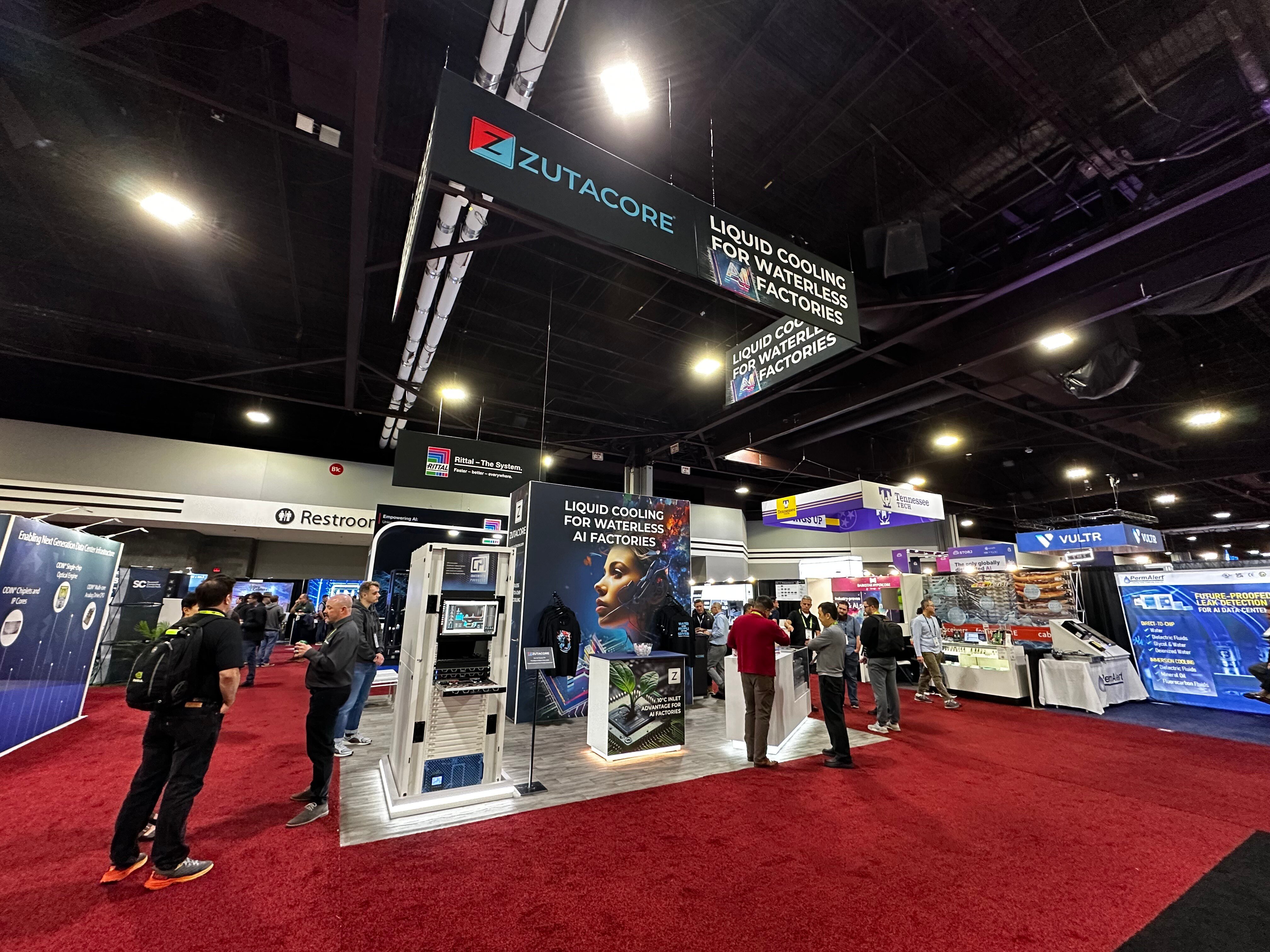
"I welcome you to join the conversation in person": ZutaCore will be at Datacloud USA in Austin, September 2–3. Catch our panel on cooling approaches for high-density workloads, chaired by Brian Lillie, President and Chief Operating Officer, or stop by the ZutaCore booth to see HyperCool in action.
Frequently Asked Questions
What is responsible AI infrastructure?
Responsible AI infrastructure is compute capacity designed and operated to deliver the most useful work from every unit of resource consumed. It should be measured not simply by megawatts installed, but by useful compute delivered per megawatt, water consumed, energy spent on cooling versus computing, and the extent to which existing infrastructure can be reused rather than replaced or rebuilt.
How much energy can two-phase direct-to-chip cooling save?
In independent testing, ZutaCore’s HyperCool waterless two-phase direct-to-chip cooling has reduced cooling energy consumption by up to 82% and pumping power by approximately 80% compared with water-based cooling systems, while enabling up to three times the processing capacity within the same rack footprint.
Does AI data center cooling have to consume water?
No. ZutaCore’s waterless two-phase direct-to-chip cooling removes heat directly from processors through phase change without relying on water at the server. This can significantly reduce dependence on water-based cooling infrastructure and ease pressure on local water resources as AI capacity expands.
Can existing data centers support AI workloads without new construction?
In many cases, yes. High-density liquid cooling can enable operators to increase compute density within existing facilities while reducing the cooling infrastructure required to support it. That means more AI capacity can potentially be deployed using existing power, floor space, and buildings rather than defaulting to new construction.
What pPUE can direct-to-chip liquid cooling achieve?
ZutaCore’s HyperCool technology has demonstrated partial Power Usage Effectiveness (pPUE) levels as low as 1.01–1.03 in third-party and OEM testing. At those levels, nearly all of the power measured within the tested system boundary is directed toward useful computing rather than cooling overhead—allowing more AI compute to be delivered from a fixed power envelope.
What should communities ask data center operators about AI infrastructure?
Communities should ask for measurable outcomes, not simply assurances. How much useful compute will be delivered per megawatt? How much water will the facility consume? What percentage of total energy will be spent on cooling rather than computing? How much existing infrastructure can be reused? What additional grid and mechanical infrastructure will be required? And can the design accommodate future generations of increasingly powerful silicon without requiring another major infrastructure rebuild?
Why does cooling architecture matter for next-generation GPUs?
Each new generation of AI silicon is driving higher power densities and greater thermal demands. Two-phase direct-to-chip cooling removes heat directly at the processor through phase change, enabling very high heat-flux removal while reducing the energy and infrastructure required for cooling. The result is greater potential to operate processors at their intended performance while creating a thermal architecture capable of supporting increasingly powerful generations of silicon.
%20(5).png)

 Alison Deane : Dec 3, 2024, 1:54:36 AM